
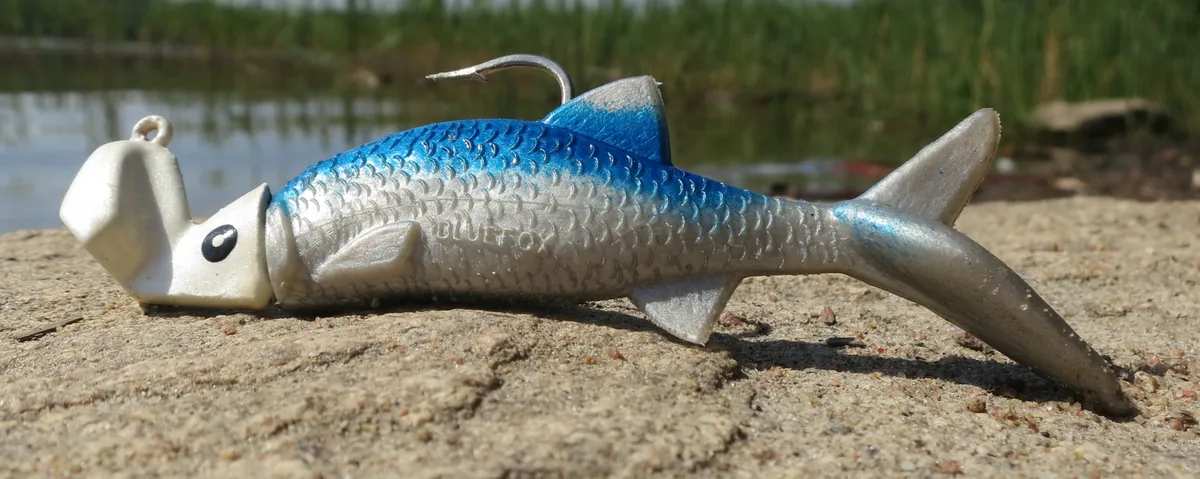
The Texas rig is the most versatile bass setup ever invented. It is a soft plastic bait on an offset worm hook with a sliding bullet weight ahead of it, rigged so the hook point is buried in the plastic and the whole thing slides through grass, wood, and docks without snagging. It catches bass in 18 inches of water and in 60 feet, in ponds and in reservoirs, and it is the first rig most bass anglers learn — for good reason.
What you need: four components
A Texas rig needs only four things. The bullet weight is a cone-shaped slip sinker, usually 1/8 to 1/2 oz, that slides freely on the line above the hook. The hook is an offset worm hook or an extra-wide-gap (EWG) hook, sized 1/0 to 5/0 to match the bait. The soft plastic is a 4- to 7-inch worm, creature bait, craw bait, or stick bait. The line is 12- to 20-pound fluorocarbon on a baitcasting setup, or 10- to 14-pound monofilament on spinning gear.
Two optional accessories solve specific problems. A bobber stop — a small rubber piece threaded onto the line above the weight — pegs the bullet weight tight against the hook eye, which keeps the rig compact when you are punching through matted vegetation or flipping into heavy cover. A glass or hard plastic bead between the weight and the hook protects the knot from the weight and adds a click on rock. Skip the bead if you peg the weight.
How to rig a Texas rig in five steps
Thread the bullet weight onto the line first, pointed end up toward the rod. The weight must slide freely — that free slide is what gives the rig its action on the fall. If you are pegging the weight, thread a bobber stop onto the line before the weight and slide it down to hold the weight tight.
Tie the hook on with a Palomar knot. The Palomar is the standard knot for a Texas rig because it is strong, simple, and seats the hook square on fluorocarbon and braid. Pass the line through the eye, double back about six inches, tie a loose overhand knot, pass the hook through the loop, wet the line, and pull tight.
Poke the hook point into the nose of the soft plastic, about a quarter inch deep, then bring it back out the same side. Slide the bait up the shank until the head covers the offset bend and the eye of the hook. Lay the hook against the body of the bait to judge where the bend sits.
Push the hook point back into the body of the bait and slide it just under the skin so it sits buried. This is the step that makes the rig weedless: the point is hidden inside the plastic, so the rig slides through grass and wood without catching, and the point only comes out when a bass crushes the bait and you set the hook.
Check that the bait hangs straight. A worm that is bunched up or crooked on the hook spins on the retrieve and catches nothing. If it does not hang straight, re-rig it. This thirty-second check is the difference between a rig that catches fish and one that just gets wet.
Choosing the hook: offset worm hook vs EWG
An offset worm hook has a shank bent slightly to one side, which helps bury the point into the plastic and keeps the rig weedless. It is the best choice for finesse baits, weightless rigs, and 4- to 6-inch worms. Use sizes 1/0 to 3/0 for these baits.
An extra-wide-gap (EWG) hook has a wider gap between the shank and the point, which gives bulky soft plastics room to collapse on the hookset. It is the best choice for thick creature baits, beaver-style baits, and large craws. Use sizes 3/0 to 5/0 for these baits. The rule is simple: the hook gap should be at least as wide as the thickest part of the bait, or the plastic will ball up in the bend and block the hook point when you set.
Choosing the weight: match it to the depth
Weight size is a depth decision, not a preference. In 1 to 5 feet of water, use 1/16 to 1/8 oz — a light weight gives a slow, natural fall that shallow bass will eat. At 10 feet and deeper, or in wind, use 1/4 oz or heavier so the rig actually reaches the bottom. For punching through matted vegetation, use 3/4 to 1 1/2 oz, pegged tight to the bait with a bobber stop.
Too heavy and you snag, or the bait falls too fast for a bass to eat it. Too light and you never reach the fish, or the wind blows your line into a bow and you cannot feel the bottom. When in doubt, start with 1/4 oz — it is the most versatile size — and adjust from there based on what the water tells you.
Tungsten weights are worth the extra cost in heavy cover. Tungsten is denser than lead, so a tungsten bullet weight is smaller for the same weight, which slips through grass and wood more cleanly, and it transmits bottom contact better — you feel rocks, wood, and bites more clearly. Lead is fine for open water and learning the rig.
How to fish a Texas rig
Cast past the cover, not into it. The rig should fall into the cover from the far side, so it lands where the bass are holding and you can work it back toward you through the strike zone. Casting directly onto a laydown or a dock usually means the rig lands on top of the wood and never gets to the fish.
Let the rig fall to the bottom on a slack line. Most bites come on the fall, and a tight line during the fall kills the bait’s action and masks the bite. Watch the line as it falls — a twitch, a sudden slack, or the line moving sideways is a bite. A cheap clip-on thermometer tells you more about where the bass are than electronics, but the line tells you when one has eaten.
Work the rig with a lift-and-fall. Lift the rod tip about a foot, then let the rig fall back to the bottom on a slack line. Repeat. The bait spends most of its time falling, which is when bass eat it. A steady retrieve is the most common mistake with a Texas rig — it turns a bottom bait into a mid-water bait and takes it out of the zone where the bass are feeding.
Set the hook on weight, not on the twitch. When you feel the line go heavy or the rod load up, reel down until the line is tight and set the hook with a firm sweep to the side. Do not set on the first twitch of the line — that is often the bass picking the bait up and moving with it, and setting too early pulls the rig out of the fish’s mouth.
Where a Texas rig wins
The Texas rig wins in cover. Grass, brush, wood, docks, laydowns, rock piles — anywhere a bass can hide and an exposed hook would snag. It is the rig for fishing the thick stuff, and the thicker the cover, the more it outfishes everything else in the box. Virginia’s Department of Wildlife Resources recommends it for largemouth and smallmouth bass, pike, and pickerel, from the bank of a warm-water pond or around deep structure from a boat.
It also wins when the bite is slow. A Texas rig fished slowly, with long pauses on the bottom, will catch bass on days when a crankbait will not — because it stays in front of the fish, in the cover, looking like food that is not in a hurry. When the fishing is tough, slow down and fish a Texas rig into the thickest cover you can find.
Common mistakes
The most common mistake is rigging the bait crooked. A worm that hangs off the hook at an angle spins on the fall, and a spinning worm does not look like food. Take the thirty seconds to re-rig it straight.
The second mistake is fishing it too fast. A Texas rig is a slow bait. If you are reeling it steadily back to the boat, you are not fishing it — you are retrieving it. Lift, fall, pause, repeat.
The third mistake is using too heavy a weight in shallow water. A 1/2 oz weight in 3 feet of water falls like a rock and never gives a bass time to eat. Match the weight to the depth, and let the bait fall naturally.