
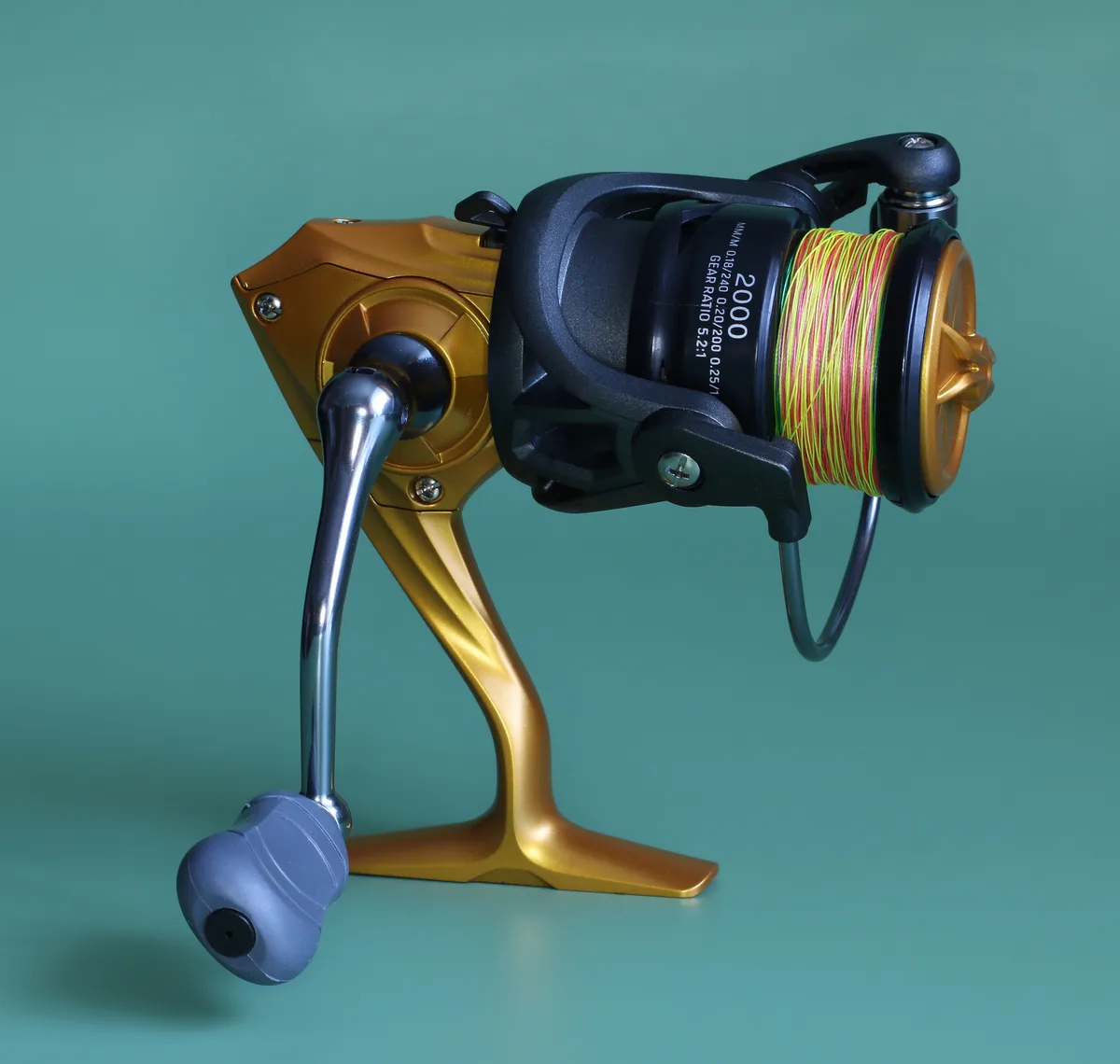
There is no single best bass fishing line. There are three lines, and each one wins in a different situation. Monofilament is the forgiving all-rounder. Fluorocarbon is the nearly invisible line for clear water. Braid is the strongest, most sensitive line for heavy cover. The anglers who catch the most bass are not the ones with the most expensive line — they are the ones who use the right line for the technique they are fishing.
Monofilament: the forgiving all-rounder
Monofilament is the best line for a beginner. It is cheap, it stretches under load (which cushions hard hooksets and keeps a bass from tearing a hook free during the fight), and it is the easiest line to tie knots with. It floats, which makes it the right line for topwater lures. A 10- to 12-pound monofilament on a spinning or spincast reel is the easiest bass setup to learn on.
The trade-offs are real. Monofilament stretches 25 to 30 percent, so it is the least sensitive of the three lines — you feel the bottom and the bite less clearly. It is more visible underwater than fluorocarbon, which can spook pressured bass in clear water. And it degrades faster than the other two: UV exposure breaks it down, so it should be replaced every season, or every 20 to 30 trips.
Use monofilament for topwater lures, for crankbaits with treble hooks (where the stretch keeps a bass from throwing the lure), and as a beginner’s all-around line. Berkley Trilene XL and Stren Original are two widely used monofilaments for bass fishing.
Fluorocarbon: the invisible line
Fluorocarbon is the best all-around line for bass fishing once you are past the beginner stage. It is nearly invisible underwater, because its refractive index (1.42) is close to water (1.33), while nylon monofilament is 1.62 — that is why fish see through fluorocarbon and see monofilament. It sinks, which keeps it in contact with a bottom bait and helps crankbaits and drop shots reach their intended depth. It has low stretch, so it is more sensitive than mono, and it resists abrasion better, which matters around rocks, laydowns, and dock pilings.
For most bass fishing, 12 lb fluorocarbon is the single best answer. It handles finesse techniques, medium-action presentations, and clear water without requiring a leader setup. Drop to 6 to 10 lb fluorocarbon for finesse rigs — a drop shot, a Ned rig, a shaky head — in clear water. Step up to 15 to 20 lb fluorocarbon for Texas rigs and jigs in wood or rock, where abrasion resistance matters. Seaguar InvizX is the most widely trusted fluorocarbon for bass, and Seaguar invented fluorocarbon fishing line; Berkley Vanish is another common choice.
The trade-offs: fluorocarbon sinks, so it is the wrong line for topwater lures that need to stay on the surface. It is stiffer than mono, so it can be harder to manage on a spinning reel, especially in lighter tests. And it costs more than monofilament. But for clear water, bottom baits, and crankbaits, it is the line that catches the most bass.
Braid: the strength and sensitivity king
Braided line has the highest strength-to-diameter ratio of any fishing line. A 30 lb braid has roughly the same diameter as 8 lb monofilament, which means you can pack more line on a reel and cast farther. It has close to zero stretch, so it transmits everything — the bottom, the bite, the grass — directly to your hand, and it gives you an explosive hookset. PowerPro and Sufix 832 are two popular braids among tournament bass anglers.
Use braid for heavy cover. Thick grass, lily pads, laydowns, dock pilings — anywhere you need to drag a bass out of vegetation, braid is the line. For frogs and flipping in heavy cover, 40 to 65 lb braid is the standard. For general heavy-cover work, 30 to 50 lb braid is the range. Braid also floats, which makes it a good line for topwater frogs over mats.
The trade-offs are significant. Braid is highly visible underwater, which is why most anglers pair it with a fluorocarbon leader in clear water. It has poor abrasion resistance against rock compared to fluorocarbon. And it cuts through vegetation instead of deflecting off it, which can be a problem when you want a lure to deflect. Braid also needs a knot that grips it — the Uni knot or a well-tied Palomar — because an Improved Clinch can slip on braid.
Which pound test for which technique
Pound test is the rated breaking strength of the line. The rule is to match the line to the cover and the technique, not to the size of the fish — a 2 lb bass in thick grass needs heavier line than a 5 lb bass in open water, because the grass is what breaks the line, not the fish.
For all-around bass fishing, 10 to 14 lb monofilament or fluorocarbon is the sweet spot. For finesse (drop shot, shaky head, Ned rig), use 6 to 10 lb fluorocarbon, often on a braid main line. For crankbaits, use 10 to 15 lb fluorocarbon. For spinnerbaits and chatterbaits, use 12 to 20 lb fluorocarbon or mono. For topwater, use 12 to 17 lb mono, or braid. For frogs, flipping, and heavy cover, use 40 to 65 lb braid. For Texas rigs and jigs in wood or rock, use 15 to 20 lb fluorocarbon.
Do not over-line. Twenty-pound mono on a medium spinning rod is stiff, hard to cast, and unnecessary for most bass fishing. Heavier line is thicker and more visible, and it can reduce lure action and casting distance. Match the line to the technique, and go lighter when the cover allows it.
The pro move: braid main line with a fluorocarbon leader
The most versatile setup in bass fishing is a braid main line with a fluorocarbon leader. The braid gives you strength, sensitivity, and casting distance; the fluorocarbon leader gives you invisibility and abrasion resistance where it matters — at the business end, near the lure. Join them with a Double Uni knot, or an FG knot if you have learned it, and use a 2- to 4-foot leader.
For one spinning rod, the standard setup is 10 lb braid to a 6- to 8-lb fluorocarbon leader. That one combination fishes finesse rigs, weightless stick baits, and light Texas rigs in clear water, and it is the setup many experienced anglers reach for first. The braid casts a light bait far, and the leader is hard for the bass to see.
When to replace your line
Line wears out, and worn line breaks on the best fish of the day. Monofilament should be replaced every season, or every 20 to 30 trips, because UV exposure degrades it. Fluorocarbon lasts 2 to 3 years, but it should be replaced after heavy use or if it feels nicked or curled. Braid lasts 3 to 5 years, but the first few feet — the part that sees the most abrasion — should be cut off and retied regularly.
Check the last foot of line above the knot every hour, and after every fish and every snag. Run your fingers over it. If it feels nicked, rough, or curled, cut it off and re-tie. A nicked line breaks at the nick, and it breaks on the fish you wanted most.