
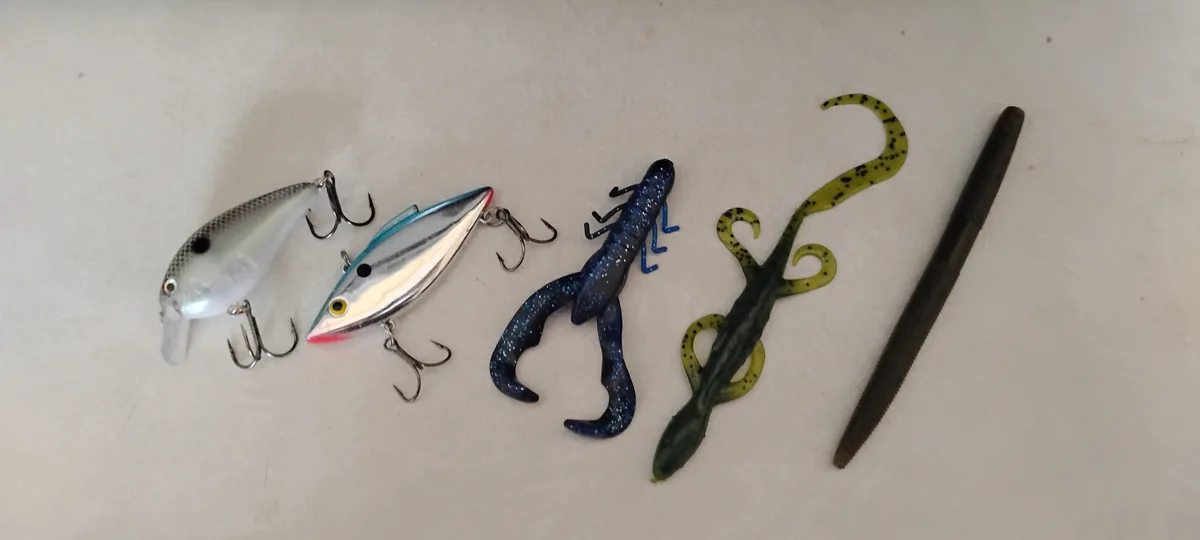
You do not need a hundred lures to catch bass. Ten lures, fished in the right place at the right time, will catch bass on almost any lake in the country. This list is those ten, ranked by how often they actually produce for a beginner — not by how many of them are hanging on the wall at the tackle shop.
1. Stick bait (Gary Yamamoto Senko and its rivals)
A stick bait is the single highest-percentage bass lure ever made. It is a soft plastic stick, usually 5 inches long, that shimmers and wobbles as it falls on a slack line — and that falling action is what bass cannot resist. Rig it weightless on a wide-gap hook and let it sink slowly beside cover.
The original is the Gary Yamamoto Senko, and it is still the benchmark other stick baits are measured against. The most productive color is green pumpkin, with watermelon as the close second. Fish it in clear to slightly stained water, around docks, laydowns, and grass edges, and let it fall on a slack line — the bite almost always comes on the fall, so watch the line for a twitch or a sudden slack.
2. Texas-rigged soft plastic worm
A Texas-rigged worm is the workhorse of bass fishing. It is a 6- to 7-inch soft plastic worm on an offset worm hook with a sliding bullet weight, rigged weedless so it slides through grass, brush, and wood where bass hide. No other lure fishes heavy cover as cleanly.
Use a 3/0 hook for a 6-inch worm and a 4/0 for a 7- to 8-inch worm, with a 1/8 to 1/4 oz bullet weight in shallow water. Green pumpkin and watermelon are the default colors in clear water; junebug and black-blue are the picks in stained water. Drag it slowly along the bottom, lift and let it fall, and set the hook when you feel weight — not when you see the line twitch.
3. Squarebill crankbait
A squarebill crankbait is the best lure for finding bass in shallow water. Its square diving lip lets it crash through wood and rock and deflect off cover instead of hanging up, and that deflection is usually what triggers the strike. It runs 2 to 5 feet deep, which is where bass feed in spring and fall.
Throw it at anything solid — laydowns, stump fields, riprap, dock posts — and reel it steadily until it bumps. When it deflects, pause for a beat. A crawfish pattern is the highest-percentage color in spring, when bass are feeding heavily on crawfish; a shad pattern is the pick when baitfish are the main forage.
4. Spinnerbait
A spinnerbait is the lure for wind, stained water, and covering ground. Its flashing blades and thumping vibration let bass find it when they cannot see it, and it comes through grass and wood far better than a crankbait. It is the best search bait in a beginner’s box.
A 3/8 oz spinnerbait is the standard all-around size. White and chartreuse is the most productive color combination in most conditions; a single Colorado blade puts out more thump in muddy water, while a double willow-leaf blade gives more flash in clear water. Reel it just fast enough to keep the blades turning, and count it down to the depth where the fish are holding instead of reeling it straight back across the surface.
5. Football jig
A football jig is the big-fish lure. It is a lead head shaped like a football, with a silicone skirt and a soft plastic trailer, dragged slowly along the bottom where the largest bass in a lake usually live. It catches fewer fish than a crankbait, but the fish it catches tend to be bigger.
A 3/8 oz jig is the all-around size for most water. Drag it, hop it, or swim it along rock, points, and ledges, keeping the line semi-taut so you can feel the subtle tick of a bite. A craw-style trailer in green pumpkin is the default; switch to a chunk-style trailer in cold water, when a smaller profile and a slower drag keep the bait in front of sluggish fish longer.
6. Topwater frog
A topwater frog is the lure for matted vegetation and the most exciting bite in bass fishing. It is a hollow-bodied frog that floats on top of grass mats, lily pads, and slop, and bass explode on it from below. It fishes water that no other lure can reach.
Use 40 to 65 lb braided line for frog fishing, because you are dragging a fish out of thick vegetation and light line will not do it. Cast past the mat, walk the frog across it with short rod twitches, and pause it in the open pockets. When a bass blows up on it, wait until you feel the weight of the fish before you set the hook — setting on the splash pulls the frog out of the fish’s mouth.
7. Jerkbait
A jerkbait is the cold-water lure. It is a slender minnow-shaped hard bait, fished with a jerk-jerk-pause retrieve that makes it dart and suspend — and that long pause is when a cold, sluggish bass finally decides to eat. It is the highest-percentage lure in water below 55°F.
A suspending jerkbait in a shad pattern is the standard. Cast it out, jerk the rod tip twice, then pause for three to five seconds — longer in colder water. The bite usually comes on the pause, and it often feels like nothing more than the line going slightly heavy. Keep the pauses long; the most common mistake is jerking too often and never letting the bait sit still.
8. Chatterbait (bladed jig)
A chatterbait is a bladed jig — a jig head with a hex-shaped blade that vibrates and flashes as it swims. It combines the vibration of a spinnerbait with the profile of a jig, and it is one of the best lures for fishing shallow grass and stained water in spring.
A 3/8 oz chatterbait in white or chartreuse is the standard. Fish it with a steady retrieve through grass, letting the blade thump, and add a soft plastic trailer for bulk. It shines around submerged vegetation and along grass lines, where its vibration helps bass find it in water they cannot see through.
9. Swimbait
A swimbait is the lure that imitates a real baitfish most convincingly. It is a soft or hard bait shaped like a shad, bluegill, or trout, with a tail that kicks as it swims. It is the best choice when bass are keyed on baitfish — especially in fall, when shad school up, and in clear water, where bass can study a lure closely.
A 3- to 4-inch paddle-tail swimbait on a jig head is the most versatile size for a beginner. Fish it with a slow, steady retrieve along points and drop-offs, keeping it at the depth where you mark baitfish. It is not a lure to fish fast; the tail does the work, and a steady retrieve lets the bait look like a real fish cruising, not a lure being reeled in.
10. Ned rig
A Ned rig is the lure for tough days. It is a small mushroom-head jig with a short soft plastic stick bait, fished with a slow drag-and-pause along the bottom. It looks like nothing, and that is exactly why it works — on heavily pressured lakes and in clear water, it catches bass that have seen every other lure in the shop.
A 1/16 to 1/8 oz Ned head with a 2.75-inch stick bait in green pumpkin is the standard setup, fished on light line (6 to 10 lb fluorocarbon). Drag it slowly, pause, and let it sit. The bite is often just the line going slightly heavy. It will not catch the most fish on a good day, but on a bad day it will catch fish when nothing else does.
How to choose which lure to throw
Match the lure to the depth first. Bass feed in a specific depth band on any given day, and a lure fished above or below that band is invisible to them. In spring, when bass are on shallow flats in 2 to 8 feet of water, a squarebill, a spinnerbait, and a Texas rig are the right calls. In summer, when bass go deeper or tighter to shade, a jig and a Texas rig fished into cover do the work. In fall, when baitfish school up, a swimbait and a crankbait are the picks.
Match the lure to the cover second. Heavy grass and wood call for weedless lures — a Texas rig, a frog, or a jig. Open water and points call for moving baits — a crankbait, a spinnerbait, or a swimbait. Fishing a crankbait through thick grass is a waste of a cast; fishing a frog over open water is the same mistake in reverse.
Match the lure to the water clarity third. In clear water, natural colors and smaller profiles work best — green pumpkin, watermelon, shad patterns. In stained or muddy water, brighter colors and more vibration win — chartreuse, white, black-blue, and lures with blades or rattles that bass can find by feel.
The five-lure starter box
If you are building a box from scratch, start with these five and learn them properly before buying anything else: a 5-inch stick bait in green pumpkin, a 3/8 oz spinnerbait in white and chartreuse, a squarebill crankbait in a crawfish pattern, a 3/8 oz jig with a craw trailer, and a pack of 6-inch worms in green pumpkin. Those five lures, fished in the right depth and cover, will catch bass on almost any lake. The rest of the tackle shop is refinement, not requirement.